

Funeral Directing – a prime Upholders craft
Exploring the historic link between Upholders and the funeral profession
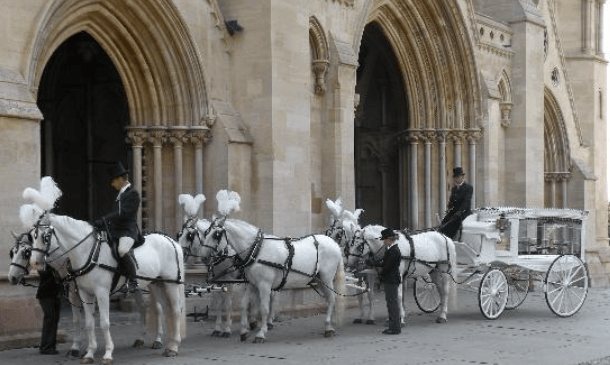
The Worshipful Company of Upholders champions several related crafts: upholstery, soft furnishings, auctioneering and funeral directing; through its activities in training, education, awards, and collaboration with industry representatives and practitioners. The Company’s longstanding involvement in funeral services dates back centuries, as its Liverymen helped shape undertaking in Britain. This historic connection continues today through funeral professionals associated with the Company.
Historical Background
The Worshipful Company of Upholders, established in 1360 but granted its first Royal Charter in 1626, originally represented craftsmen specialising in upholstery, furniture, and related trades. At the time, the specific profession of funeral directing, then known as undertaking, had not yet emerged as a distinct occupation. Instead, the provision of funeral products and services was often associated with the Worshipful Companies of Painter-Stainers and Drapers. These companies were regularly commissioned by the Heralds of the College of Arms to create standards, banners, palls, and armorial emblems for noble funerals, which were known as heraldic funerals and largely exclusive to the aristocracy until the late 17th century.
The Emergence of Undertakers
The landscape began to shift in the late 17th century, when advertisements started to appear offering services similar to those provided by the College of Arms to the broader public, essentially creating the birth of commercial funeral directing. By the early 18th century, many Upholders found it lucrative to supplement their income by acting as undertakers. This marked a significant development, as the provision of funeral services became a common additional revenue stream for Upholders, solidifying their involvement in the funeral profession.
Keen to protect their business interests, in the 19thCentury the Worshipful Company of Upholders reportedly lobbied vigorously against the newly formed United Company of Undertakers, seeking to prevent them from attaining livery status, a prestigious designation within the City of London. At that time, admission to the Upholders was denied to those solely engaged in undertaking, reflecting a desire to maintain traditional boundaries and safeguard their craft. Nevertheless, the Upholders’ connection to the funeral profession deepened over the centuries, as they continued to provide services and products essential to funerals.
Although some still make their own coffins, most modern funeral directors buy them from specialist manufacturers and line them in a choice of fabric selected by the family that they are serving, making it very natural that the Upholders should be the Livery Company most closely aligned to the trade.
Modern Connections
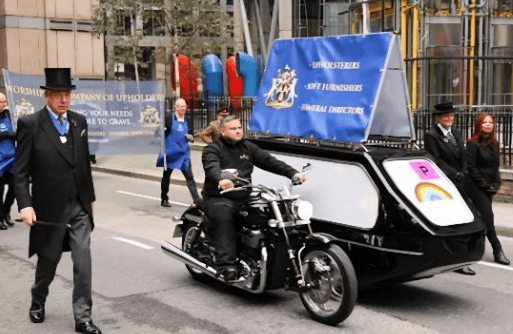
In recent decades, the profession has evolved considerably to meet the changing expectations of society. Funerals are increasingly seen as opportunities to celebrate the life and achievements of the deceased, moving away from strictly traditional events that capture the individual’s character, passions, and interests. This shift is particularly evident in the rise of bespoke funeral options, such as Motorcycle Funerals, founded by the late Reverend Paul Sinclair, which offer motorbike and sidecar hearses for those who cherished biking. Such personalised tributes provide families with meaningful ways to honour their loved ones in a manner that reflects their unique identity.
Moreover, the profession has adapted to the diverse cultural and religious beliefs present across Britain’s four nations. Funeral directors now routinely facilitate ceremonies that embrace individual needs, ranging from secular celebrations of life to traditional rituals from various faiths. The guiding principle is to lay the deceased to rest with dignity, authenticity, and respect, while helping families build lasting memories and tributes for a life well lived. This approach underscores the profession’s commitment to supporting people through grief with compassion, flexibility, and creativity.
Many prominent funeral professionals have been Freeman or Liverymen of the Upholders and they have been proud to provide their services to some of the Nation’s most notable and eminent people. Today, the bond between the Upholders and the funeral profession remains strong and enduring. This longstanding relationship highlights the Upholders’ integral role in shaping and supporting the funeral industry throughout history.
The Funeral Pall
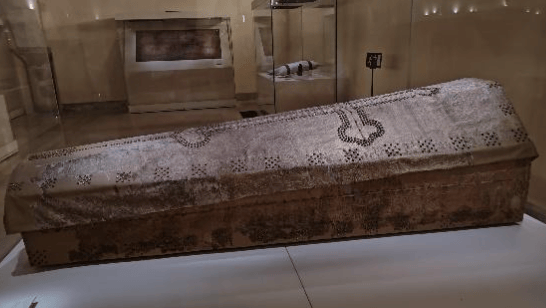
The funeral pall is a cloth, traditionally draped over a coffin or casket during funeral ceremonies. Deeply rooted in ritual and symbolism, the pall serves as both a practical and emblematic element, signifying respect, dignity, and the equality of all before death. Its presence in funerals, from medieval times to the present day, reflects the changing customs and beliefs surrounding mortality, remembrance, and community.
The term “pall” derives from the Latin pallium, meaning cloak or mantle. Early references to the funeral pall trace back to the use of the hearse cloth—a decorative covering for the hearse itself, rather than the coffin. Over time, the pall evolved from a cloth associated with the vehicle transporting the deceased to a covering directly placed over the coffin, symbolising the shrouding of the body and marking the transition from life to death.
During the medieval period, the funeral pall became an essential part of Christian funerals, often made of rich fabrics such as velvet, silk, or damask. Its size and materials varied according to the status of the deceased and the resources of the family or institution involved. The pall’s function transitioned from a hearse cloth to a coffin covering, amalgamating the two traditions. In many cases, palls were adorned with crosses, religious motifs, or heraldic devices, emphasising both the sacred and social aspects of the ceremony.
Guilds and Livery Companies: Traditions and Notable Examples
The ownership and use of funeral palls were particularly prominent among guilds and livery companies in Britain. These organisations often possessed elaborate palls, reflecting their communal identity and wealth. The palls were frequently embroidered with the arms or insignia of the guild, serving not only as funeral accoutrements but also as artefacts of civic pride and tradition.
Heraldic Funerals: Role of the College of Arms
In heraldic funerals, especially those of nobility and prominent figures, the College of Arms played a significant role. Funeral palls used in such contexts were often made of luxurious materials and adorned with heraldic escutcheons—shield-shaped devices displaying the deceased’s arms. The pall would be removed after the funeral service, and the escutcheons collected by the College, underscoring the ceremonial importance of heraldry in commemorating lineage and status.
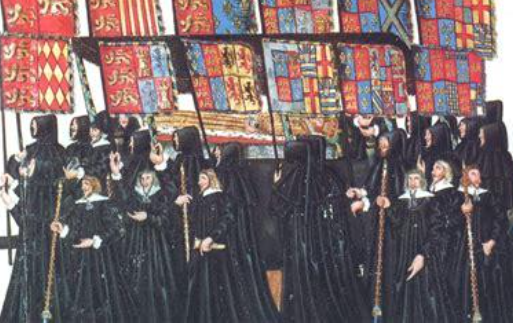
The nineteenth century saw continued use of the funeral pall, with undertakers and pallbearers assuming greater responsibility for its provision and display. Palls could be hired for funerals, and their design became more standardised, reflecting the rise of professional funeral directors. The role of the pallbearer evolved, typically referring to those who carried the coffin, but also those who assisted in holding or arranging the pall during the service. Despite these changes, the symbolism of the pall as a marker of dignity and solemnity remained unchanged.
Modern Practices: Secular and Religious Contexts
Today, funeral palls are used across a variety of contexts, both secular and religious. Funeral directors often supply simple palls for services, while churches retain traditional palls for liturgical use, frequently decorated with crosses or other Christian symbols. In some cases, the colour and design of the pall reflect the liturgical season or the personal wishes of the deceased’s family. The pall continues to signify the covering of the deceased, embodying themes of equality and reverence, regardless of social status or denomination.
Symbolism and Design
The symbolism of the funeral pall is multifaceted. Its design often incorporates motifs of faith, hope, and remembrance, such as crosses, lilies, or heraldic devices. The colour of the pall—commonly white, black, navy, purple, or gold—can denote purity, mourning, royalty, or resurrection, depending on the context. In religious ceremonies, the pall reminds attendees of the Christian belief in resurrection and the dignity of all souls. In secular settings, it serves as a visual marker of respect and the collective nature of mourning.
Enduring Legacy and Meaning of the Funeral Pall
Our 400th Charter Anniversary project will result in the creation of our own beautiful pall. Predominantly, the artefact will be viewed as an artwork, displayed in its framed circular format as the Circle of Life. Its innovative design, however, enables the work to be transformed into a funeral pall, through the removal of many of the most detailed panels which are then remounted onto a traditional luxury wool cloth.
Throughout centuries, the funeral pall has remained a powerful symbol of dignity, unity, and reverence for the dead. Its evolution from hearse cloth to coffin covering, its role in guilds, heraldic funerals, and modern traditions, and its enduring symbolism in both religious and secular ceremonies, attest to its significance in the rituals of farewell and remembrance. Today, the funeral pall continues to embody the values of respect and equality, ensuring that every individual is honoured in death as in life.

