A New Affiliation with HMS Vigilant
A visit to HMNB Clyde marked the start of the Upholders’ new Royal Navy partnership and offered a rare insight into life aboard a nuclear deterrent submarine.
A New Partnership
In July 2025, we sadly said farewell to HMS Triumph at her decommissioning ceremony at HMNB Devonport. As that long and successful affiliation ended, efforts were already under way to establish a new Royal Navy partnership for the Worshipful Company of Upholders, preferably with another submarine.
Lt Cdr Freddy May, formerly Executive Officer of HMS Triumph, helped secure the nomination of HMS Vigilant, a Vanguard-class nuclear-powered ballistic-missile submarine. His subsequent transfer to HMS Vigilant as Executive Officer greatly assisted the new affiliation. Unlike the hunter submarine HMS Triumph, HMS Vigilant is a bomber carrying the Trident ballistic missile, the United Kingdom’s nuclear deterrent—a distinction that inspires friendly rivalry between their crews. Commissioned in October 1995, HMS Vigilant is expected to remain in service for some time.
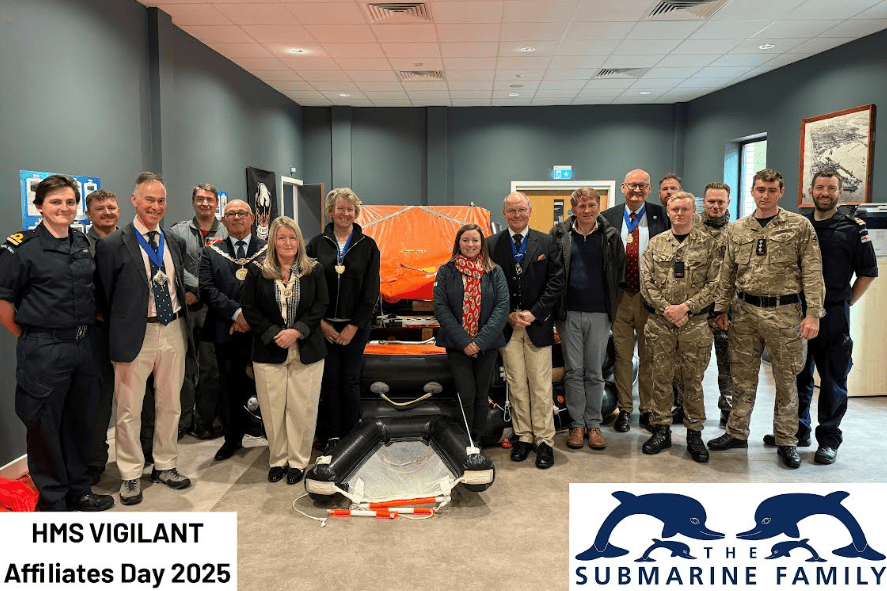
As the partnership took shape, the Company was invited to HMS Vigilant’s Affiliates Day at HMNB Clyde, Faslane, on 12 October 2025, where an Affiliates MOU would formalise the relationship. Master Roger Wates, Past Master Anthony Demby, Clerk Rosemary Selfe and Court Assistant John Freemantle travelled to Scotland and met Lt Cdr May and Lt George Holland for dinner in Helensburgh the evening before. Both officers had been instrumental in arranging the visit and affiliation.
Training at HMNB Clyde
Despite wet weather, the day began impressively after security clearance at the Submarine Escape, Rescue, Abandonment and Survival (SMERAS) facility. Opened in 2021, it provides realistic, controlled training for submarine escape and rescue. Experienced submariners demonstrated single- and two-person escape hatches and explained their worldwide emergency-response role, reflecting a strong mutual respect among submariners of all nationalities.
In the pool, instructors demonstrated survival procedures in simulated darkness, rain, thunder, lightning and force-four seas. Even at a fraction of the facility’s maximum intensity, the exercise was striking—and made me wish I had brought a waterproof.
We next visited the Fleet Operational Standards and Training (FOST) simulator, which replicates a bomber submarine’s equipment and prepares crews for deployment. With Commanding Officer Douglas Laird, we watched a simulated engagement against “Russian” ships. In reality, a bomber submarine’s overriding objective is to remain undetected by both hostile and friendly forces.
Aboard HMS Vigilant
After lunch in the Officers’ Mess, we boarded HMS Vigilant, then out of the water in a vast hangar. A lift brought us to deck level, and we crossed a small footbridge before entering through the stern escape hatch. Inside, the modern submarine felt remarkably cramped. The bow and stern escape hatches are removed during maintenance to provide access; operationally, entry is through the conning tower.
Commander Laird briefed us on HMS Vigilant’s role and the careful planning required to avoid detection. Questions about Trident were politely deflected, though the missiles’ role as a formidable weapon of last resort was clear. He confirmed that a sealed letter from the Prime Minister is kept in a secure safe in the control area, to be opened only when directed.
Formalising the Affiliation
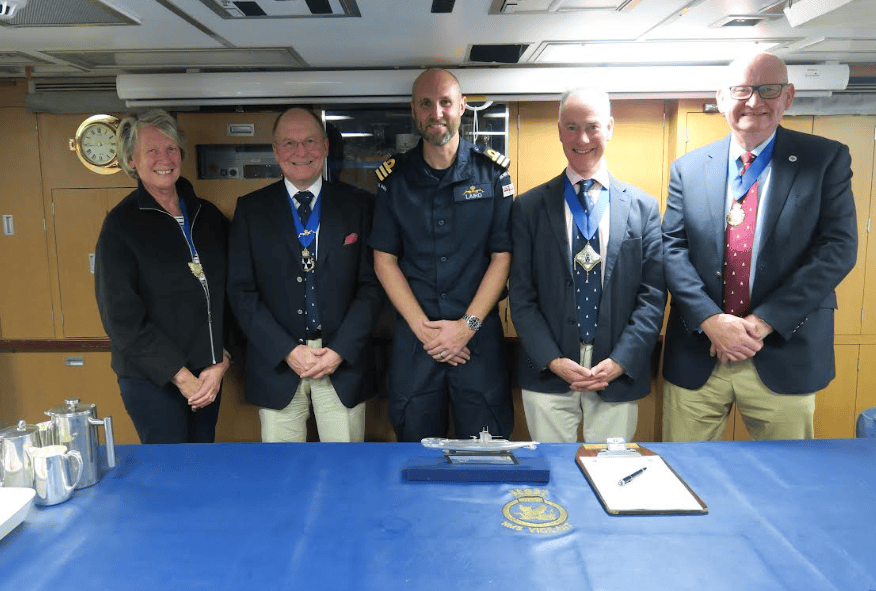
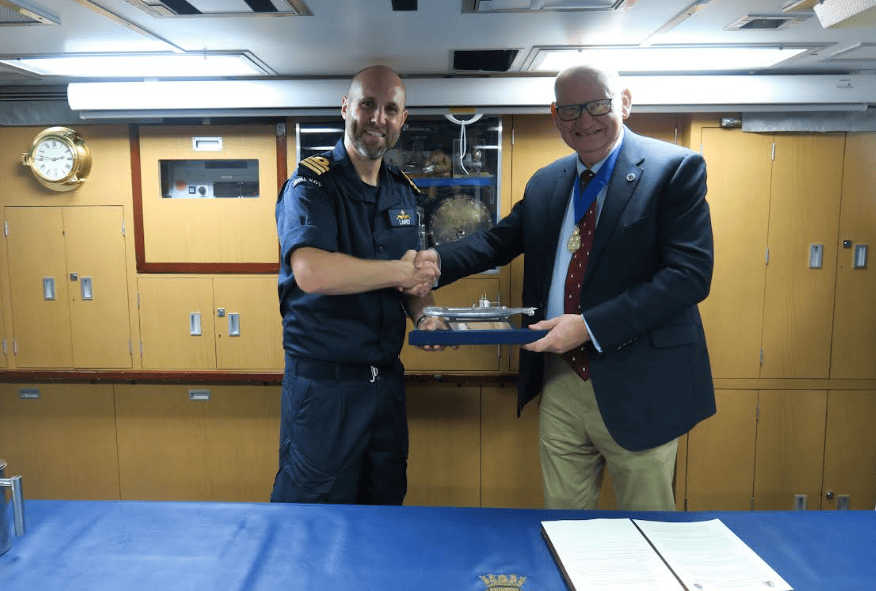
Before touring the submarine, the Upholders watched the Commanding Officer and the Master exchange remarks and sign the Affiliates MOU. I then had the privilege of handing Commander Laird custody of the Company’s silver model of the Second World War submarine HMS Upholder. The model had previously been held by the second HMS Upholder until her decommissioning in April 1994, and then by HMS Triumph until July 2025.
Life Below the Surface
The tour revealed how little of HMS Vigilant’s exterior size translates into personal space. Crew accommodation is exceptionally confined: 11 people share an area with only 45–50 cm between bunks, roughly 2 m by 3 m of floor space, and lockers no larger than filing-cabinet drawers. The crew works six-hour shifts, exercises in a small gym area and receives tightly vetted communications from home to protect morale.
The compact galley and dining area serves 130–150 crew on a six-hour rota. Limited storage requires a fixed menu and carefully organised freezers. In the control room, the equipment seen in the FOST simulator was compressed into a much smaller space alongside the Prime Minister’s document safe and the Trident firing area, underlining the need for strict procedural discipline.
Only the central missile compartment conveyed the submarine’s full scale, with 16 silos capable of holding Trident missiles. Each missile is 13.4 m tall, 2.1 m in diameter, can carry multiple warheads and has a range of thousands of miles. The operational complement is classified; one hopes they remain a deterrent and are never used in anger.
The engineers responsible for the reactor and power systems displayed a remarkable stoicism about long submerged deployments. One said he moved around so little that he once met a fellow crew member only after returning to base. The submarine surfaces only on return to HMNB Clyde, ideally without having been detected.
Reflections and Thanks
The tour was fascinating, though the narrow passages, steps and ladders were challenging—especially at 1.93 metres tall, as my sore forehead confirmed. We returned to the Officers’ Mess with even greater respect for the submariners who volunteer to serve in such demanding conditions.
We left HMNB Clyde pleasantly overwhelmed by what we had seen and by the crew’s hospitality. That evening, dinner with Commander Laird, Lt Cdr May and other junior officers gave us the chance to express our gratitude and explain what it means to be an Upholder Liveryman. Although HMS Vigilant will often be out of sight on operations, she will not be out of mind; this feels like the beginning of a strong bond between the Livery Company and the submarine.
My thanks go to Commander Douglas Laird RN, Lt Cdr Freddy May RN, Lt George Holland RN and Lt Christopher King RN for arranging and supporting the Affiliates Day. Lt Cdr May also attended our Mansion House Banquet in October 2025 and signed the Armed Forces Covenant on behalf of the military services.
We hope representatives of HMS Vigilant will be frequent guests at future Livery functions.
HMS Upholder
The second submarine named ‘Upholder’ was built by VSEL for the Royal Navy and launched by Her Royal Highness the Duchess of Kent on 2nd December 1986.
Her first Captain was Lieutenant Commander G.A.R. McCready, M.B.E., R.N., who was appointed in Command of HMS Upholder in November 1987.
After much deliberation she was also allowed to sail under Wanklyn’s crest, not the official one. She was commissioned on 9th June, 1990.
The Worshipful Company immediately adopted the new HMS Upholder as soon as she was commissioned and presented Lt. Cdr. McCready and the Ship’s Company with a silver model of the first HMS Upholder which was displayed in the submarine’s Trophy Cabinet throughout her Commission.
Members of the Court and Liverymen of the Worshipful Company enjoyed some memorable visits to the ship when she was in London and we were taken on guided tours and shown some of the truly amazing technology that seemed to fill every available nook and cranny. A few members of the Company were privileged to go to sea in her. One regular visitor in the ship’s early days was the Duchess of Kent who was affectionately known as ‘Auntie Kate’ by the crew.
This new HMS Upholder was a ‘First-of-Class’ and the first new diesel-electric submarine to enter service with the Royal Navy for some twenty years. The new ‘Upholder Class’ was, unfortunately, not to stay in service for many years and HMS Upholder was de-commissioned at the end of April 1994. The rest of the fleet of Upholder Class submarines were all de-commissioned over the next few months.
HMCS CHICOUTIMI
HMS Upholder was decommissioned and sold to the Canadian Navy and re-named HMCS CHICOUTIMI. Unfortunately during her transit to Canada the boat suffered a serious fire and was subsequently laid up in Halifax, Nova Scotia for some years.
In 2010 the Canadian Navy transported her round to the west coast to be refitted and returned to service.
In 2014 she started sea trials and was officially accepted back into the Canadian Navy on the 3rd September 2015.
In October 2015 she participated in the US Navy Task Group Exercise of California.

