Treasures of the Company
Over the centuries, The Worshipful Company of Upholders has built an interesting and diverse collection of treasures. The collection has largely grown through the generosity of Liverymen past and present, and others, with pieces often commemorating a Past Master’s year in office, associations with other organisations and national events and occasions.
The collection ranges from a 17th century salt to loving cups, goblets, rose bowls, badges of office and even two model submarines. The oldest piece in the collection dates from 1697 with our most recent pieces being designed and manufactured in the 21st century. The collection continues to grow today.
At Upholders’ events, badges of office are worn, and other pieces are displayed and used from time to time. Some of the collection can also be found on display, such as our salt (on display at Salters’ Hall) and a portrait of William Hunter (Past Master Upholder and Lord Mayor) hangs in the City of London Freemen’s School.
It is however rare to see the full collection on display. Our exhibition and celebration on 9 July 2026, commemorating the 400th anniversary of the Company being granted its Royal Charter, reunites our treasures. This online companion provides additional insights and details of our collection.
I hope you find it interesting and informative.
Antony E Usher FCA
Past Master (2006-07)
April 2026
Royal Charter
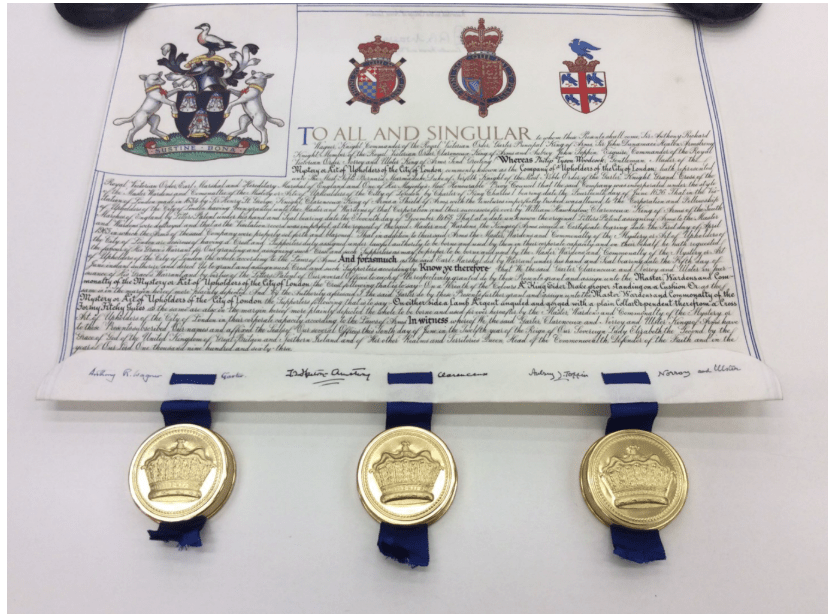
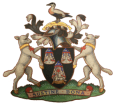
The Company received the grant of its Coat of Arms in 1465 in the reign of Edward IV, and its Royal Charter was granted by Charles I on 14 June 1626. The original Charter is thought to have been destroyed in 1666 in the Great Fire, but a new exemplification was obtained in 1668. The grant was later confirmed by Charles II.
Pictured above is a modern charter of 1963, granting the Company the use of the Eider Duck Crest and Lamb Supporter, and showing the use of wool and feathers in our Trades. It is held in the Guildhall Archives.
William III Silver Gilt Salt
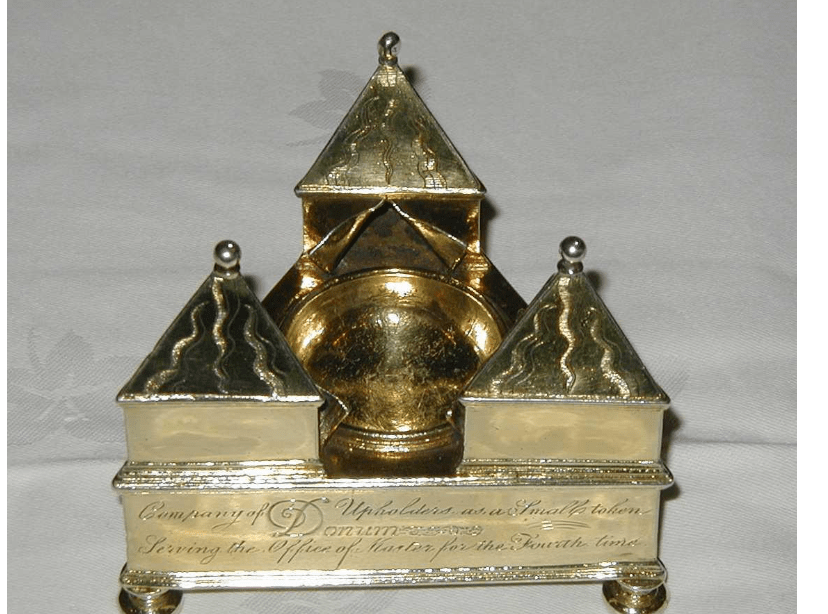
The salt was presented to the Company by Sir William Rawlins, who was Master in 1811. He also acted as Master on a number of other occasions. Sir William was elected a Common Councilman in 1787, representing Bishopsgate, and was elected a Sheriff of the City of London in 1801. Whilst in office as Sheriff he and his fellow Sheriff boycotted a visit by the Prince of Wales to the City on grounds of principle (they believed that both they and their chaplains had not received due acknowledgement of their status). Sir William was one of the wealthiest men in the upholstery trade at that time and he was knighted in 1802. In 1807 he helped found the Eagle Insurance Company (later Eagle Star), of which he was Chairman until his death. He died at his home, 13 Liverpool Street, in 1838, aged 84 and is buried in the churchyard of St. Botolph’s, Bishopsgate.
The William III Silver Gilt Salt is a very rare triangular salt with triangular steeple top tents or pavilions at each corner with openings to the centre. It is inscribed “Donum Phillippi Gibbar Societati”. The engraving on the panels reads: “Presented by Sir William Rawlins to the Company of Upholders as a small token of respect on the 2nd of August 1832, while serving the office of Master for the fourth time.” It has a wood stand and glass cover. It was Exhibited at Seaford House, No. 382, 1929, and at the Goldsmiths’ Hall Festival Exhibition, 1951. It was made by Louys Cuny of London in 1697. The salt is 4.1” high with each side measuring 3.5”.
The Crump Silver Rose Water Dish
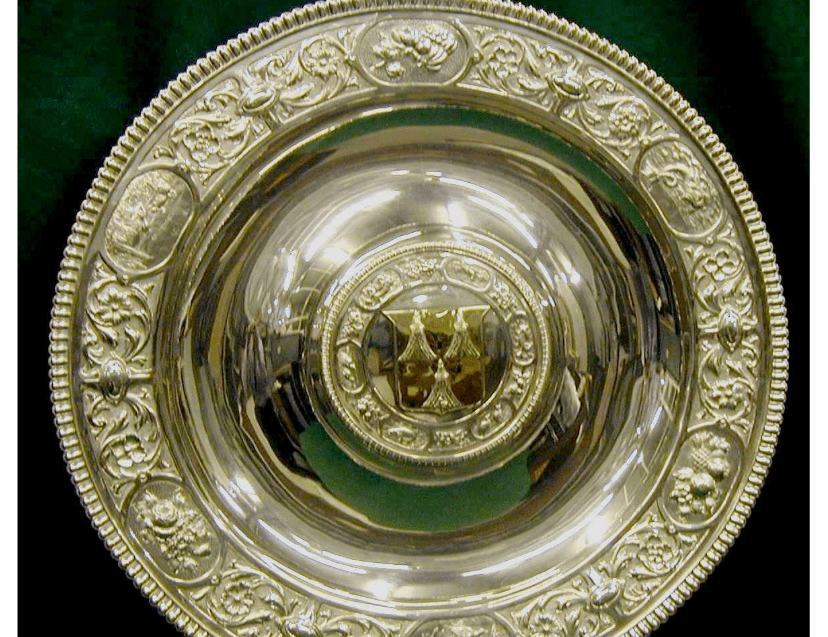
This dish was presented to the Company in 1905 by Sir William J Crump JP. He was Clerk from 1894 to 1905 and Master in 1908. In 1900-01, he was the first Mayor of the Metropolitan Borough of Islington and was appointed High Sheriff of Middlesex in 1911. A solicitor by profession, Sir William helped establish the Solicitors’ Company, of which he was Master in 1912. The dish is decorated with a design of floral scrolls with panels of fruit, hares, dolphins and birds. The centre shield is in gilt, with the Company’s arms bordered by flowers, birds and fish. The dish was made by William Comyns, London 1905, and has a diameter 19.0” and weighs 77.4oz. It is presented in a fitted wooden case.
The Cole Silver Armada Dish
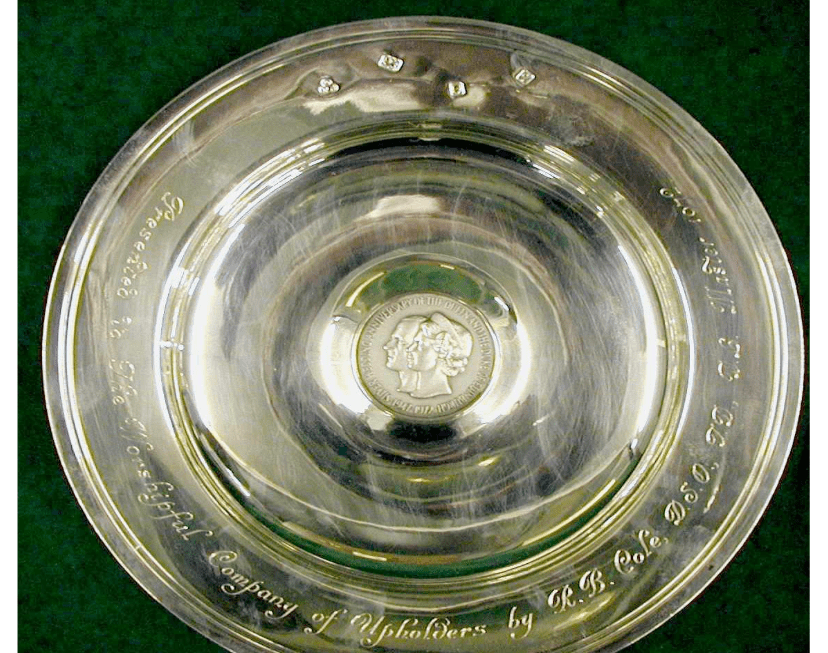
The dish was presented to the Company by Raymond Buxton Cole, DSO TD DL, Master 1972-73. The Silver Armada Dish commemorates the Silver Wedding of Queen Elizabeth II and the Duke of Edinburgh in 1972, with the central boss of the dish depicting their portraits in profile. The dish has a diameter of 10.0” and weighs 23.8oz. Made by Payne and Son, London 1971.
The Festival Rose Bowl
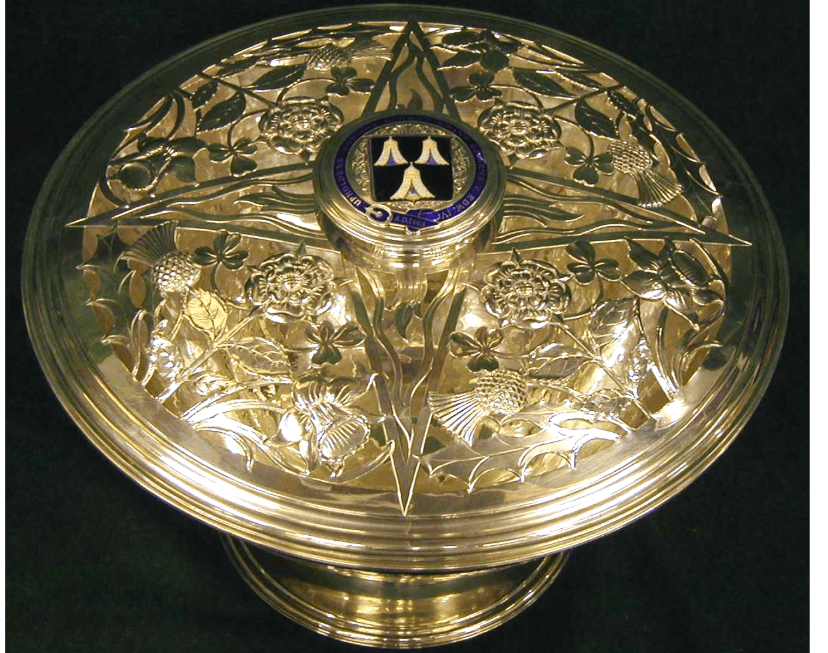
The Festival Rose Bowl was presented by the Master, Wardens and Members of the Livery to commemorate Festival year, 1951. The Bowl was designed by M E Gould and made by Mappin and Webb, Sheffield 1950. It is in silver with a tapering body on a round foot. It has a pierced cover decorated with the emblems of England, Scotland and Ireland (roses, thistles and clovers). The centre enamel boss bears the Arms of the Company in blue enamel, bordered by a ribbon giving the date of the Grant of Arms (1465). It sits on a circular foot and has a fitted oak case. It has a diameter of 14.5”, a height of 9.5” and weighs 150oz..
The Chapman Silver Rose Water Finger Bowl
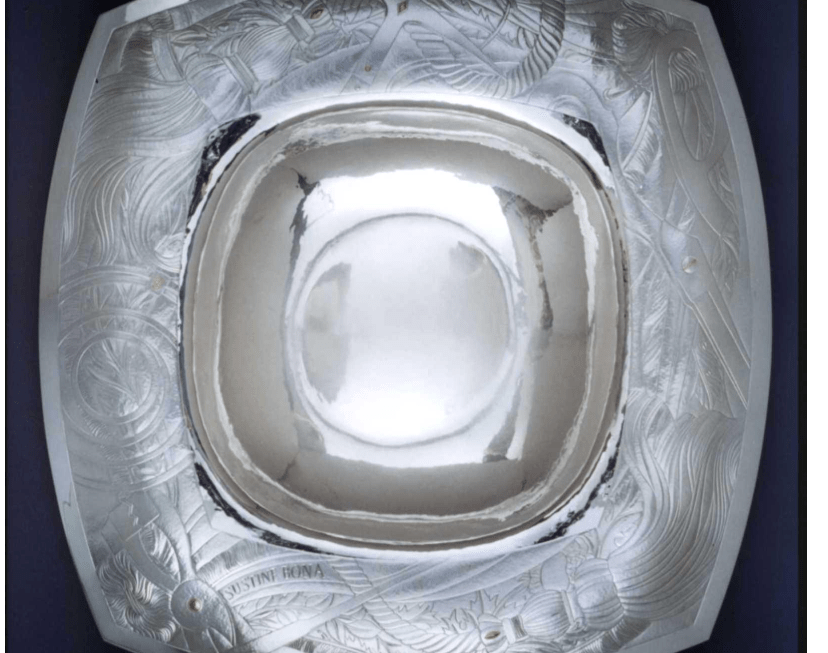
This Silver Rose Water Finger Bowl was presented by Bertram Edward Chapman MBE (Master 2000-01) on 17 April 2002. It was designed by Rod Kelly MA (RCA), London 2001. Of shaped square form, the bowl’s border is engraved with tools of the upholstery trade including a tack hammer, scissors, hide strainer, needle and regulator, as well as accessories such as coil springs, tassels and tufts, all lying on folds of decorative material. The Upholders’ motto, “Sustine Bona” is engraved in one corner. It is 16” wide and weighs 63.6oz.
The Newton Loving Cup and Cover
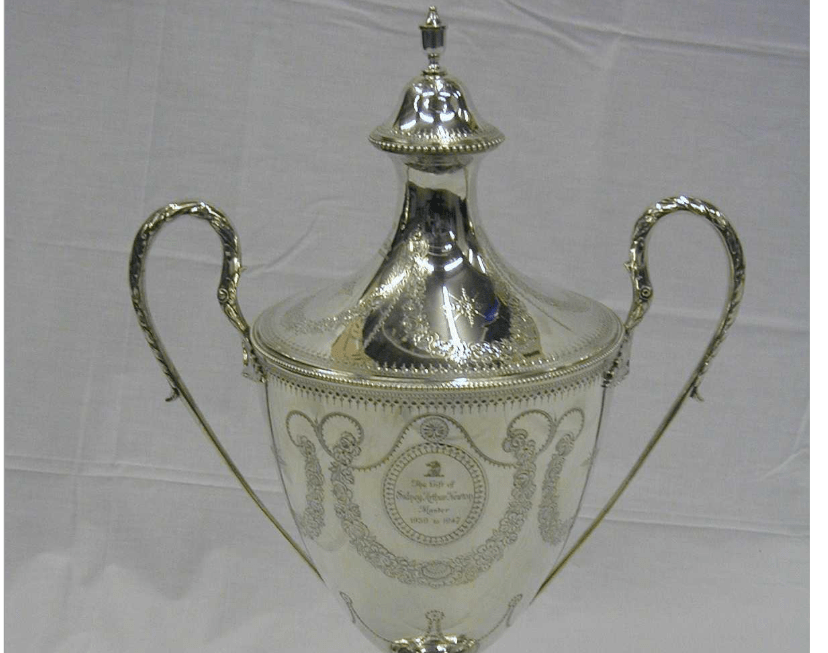
The cup was presented to the Company by Sydney Arthur Newton, Master 1939 to 1947.
The Newton Loving Cup is a George III Silver Cup with Cover. The cup is vase shaped with two handles, engraved floral festoons and a beaded edge. The cover is similarly decorated. It was made by James Young of London in 1783. The cup (with cover) stands 20.3” high and weighs 89.8oz.
King George V Coronation Cup
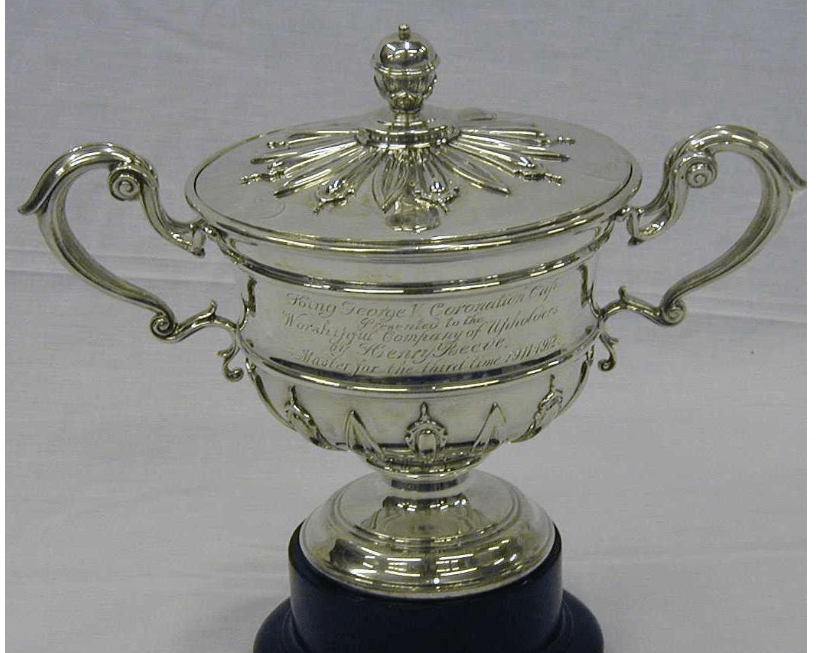
The King George V Coronation Cup was presented to the Company by Henry Reeve while Master for the third time, 1911-12. It is of tapering circular form with a the pull off cover with bud finial and cut card decoration. It has flying scroll handles and rests on a spreading circular foot. It was made by William Comyns, London 1909, and stands 7.5” high on an ebony base and weighs 28.3oz.
The Nicoll Loving Cups and Covers
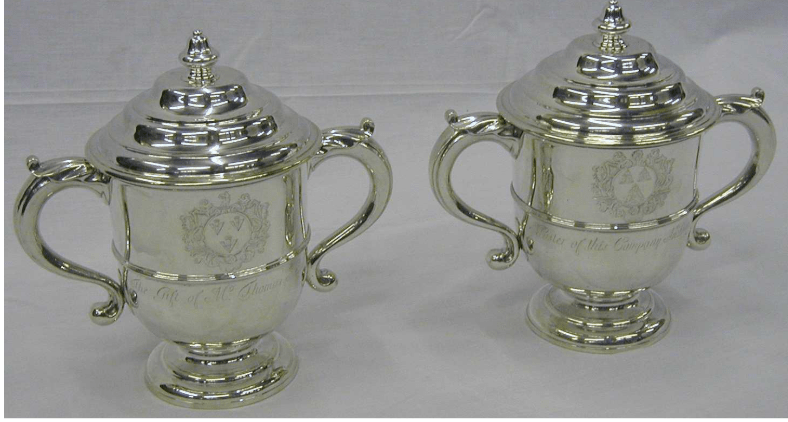
The cups were presented to the Company by Thomas Nicoll, Master 1705. They are a pair of antique silver cups and covers engraved with the arms of the Company. The cups purport to have been made by Edward Vincent in London in 1686, while the covers were made in 1904 by William
Comyns, London. Each cup (with cover) stands 8.3” high.
The Taylor-Restall Loving Cup and Cover
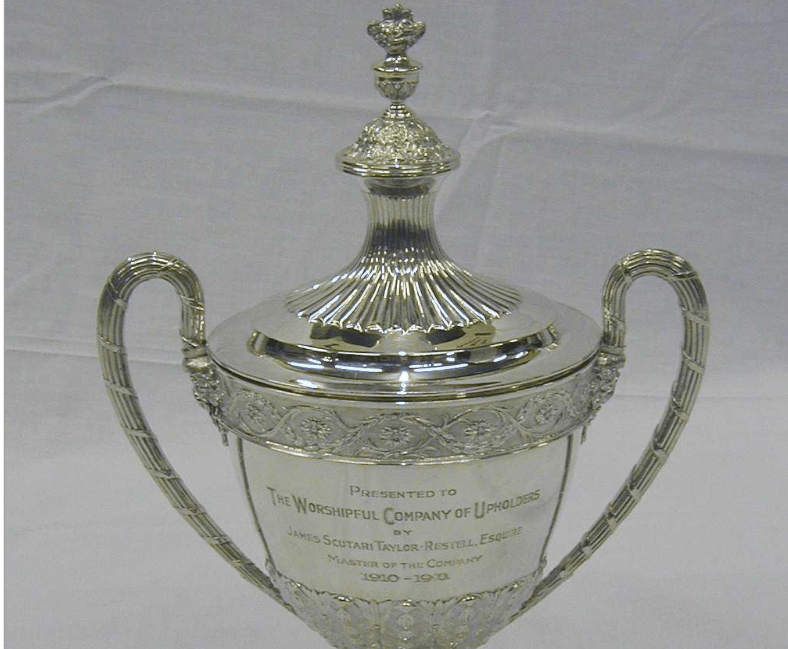
The cup was presented to the Company by James Scutari Taylor-Restell, Master 1910-11.
The Taylor-Restall Loving Cup is a modern silver cup with cover. The lower part of the body is decorated with a leaf pattern and bordered with a floral band. The handles are of a reeded and ribbon design. The cup is engraved with the arms of the company. It was made by the Goldsmiths’ and Silversmiths’ Company of London in 1907. The cup (with cover) stands 14.5” high and weighs 42.3oz.
The Exchange Cup
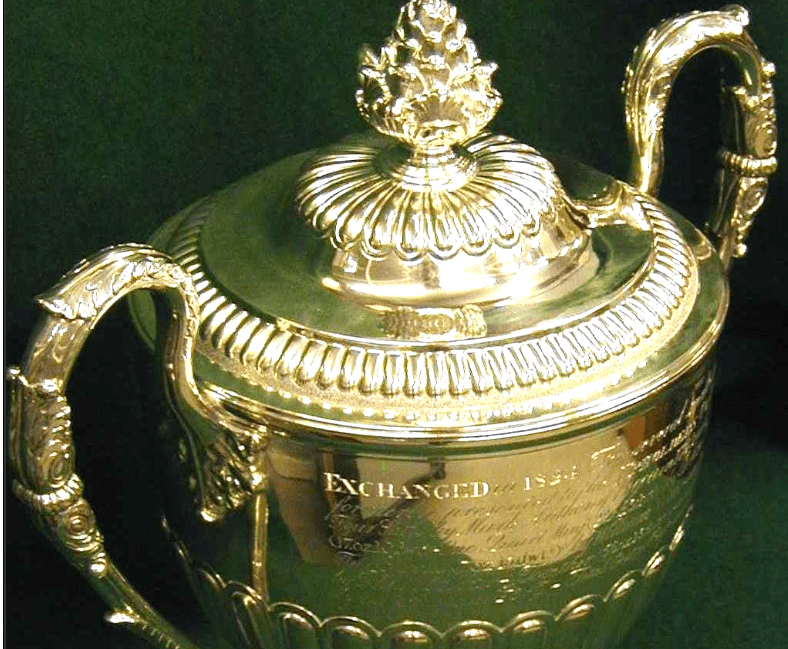
The Exchange Cup is a George III silver cup and cover. The lower part and foot of the cup are fluted and the two handles are decorated with a leaf design. It is engraved as follows: “Exchanged in 1824 for several small pieces of plate formerly presented to the Upholders Company – viz., four salts by Mark Anthony Figou in 1703, and six other salts (17 ozs. 10 dwts.) one quart mug (23 ozs. 5 dwts.) by John Tatnal in 1736. Two spoons (7 ozs. 15 dwts.) by William Storer, and one salt (8 ozs. 5dwts.) by Philip Gibbar; together (56 oz. 15 dwts.) and sold for £14.3.0. added by the Company £26.9.0. Total cost of Cup and Cover, £40.12.0.” It was made by Samuel Hennell of London in 1811. The cup (with cover) stands 16.3” high and weighs 111.6oz.
The Replica Ridges Cup
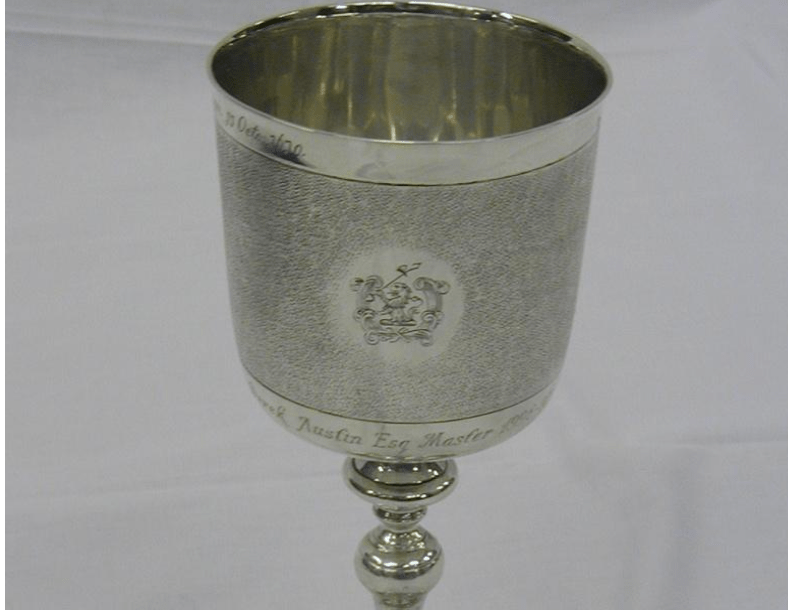
The cup was presented to the Company by Derek Stanley Austin, Master 1996-97.
The Replica Ridges Cup was made in 1927 by The Goldsmiths and Silversmiths Company Ltd and is inscribed: “Ex dono Galielmi Ridges Armigeri 13 Octo 1670”. It stands 8.8” high, and weighs 15oz.
The Charkham Cup and Cover
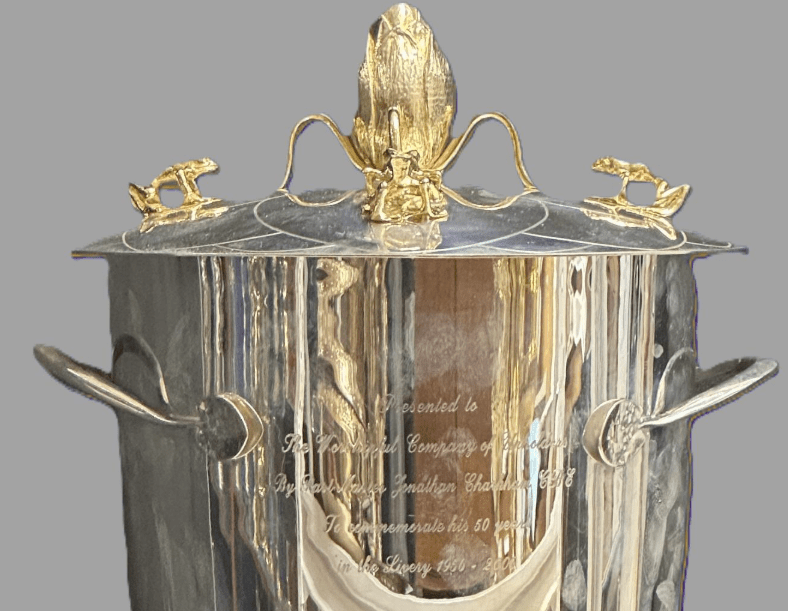
The Charkham Cup and Cover was presented to the Company in April 2006 by Past Master Jonathan Charkham. Mr Charkham (1930 – 2006) was an economist, an Adviser to the Governor Bank of England, and in 2002 served as Chief Commoner.
Made by MRB, London 2003. Circular in form, with a pull off cover decorated with four gilded models of frogs and a central bud finial. The lower body engraved with a lily pad and frog frieze. Engraved, with the arms of the Company and the inscription; “Presented to the Worshipful Company of Upholders by Past Master Jonathan Charkham, to commemorate his fifty years in the Livery, 1956-2006”. In a fitted wooden case. Height 10”, Weight 70ozs.
The Usher Cups and Covers
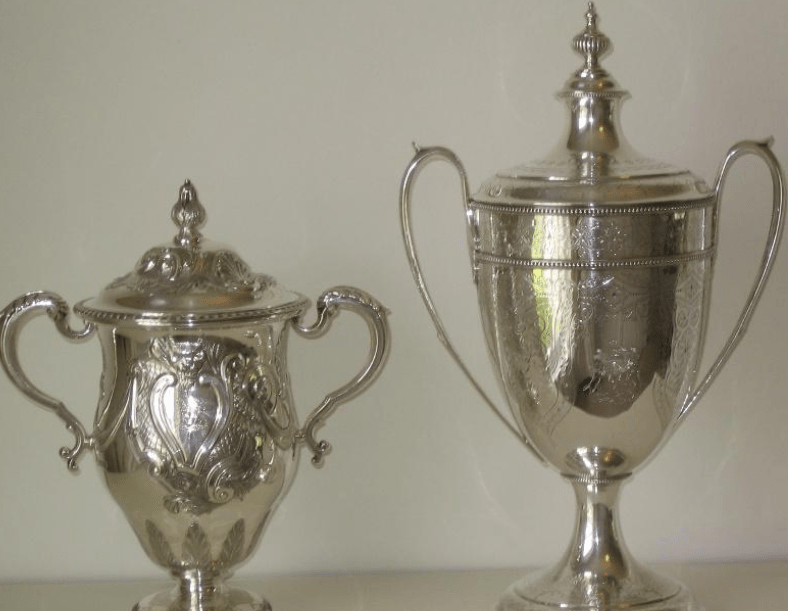
The two Usher Cups and Covers were presented to the Company in 2008 by Thoms Raymond (Ray) Usher (Master 2001-02) and his son Antony E Usher (Master 2006-7).
The larger by Edward Hutton, Sheffield 1889. Tapering circular form, the pull off cover with urn finial, loop handles, engraved with foliate scrolls. One side engraved with the Arms of the Company. Height 14.5”, weight 32ozs.
The smaller by Mappin and Webb, Sheffield 1922. Waisted circular form, pull off cover, knop finial, embossed with scrolls and swags, leaf capped scroll handles. Engraved on one side with the Company’s Arms, the other side with a presentation inscription. On a circular foot. Height 11”, weight 25.7ozs.
The Kinsey Silver Fruit Basket
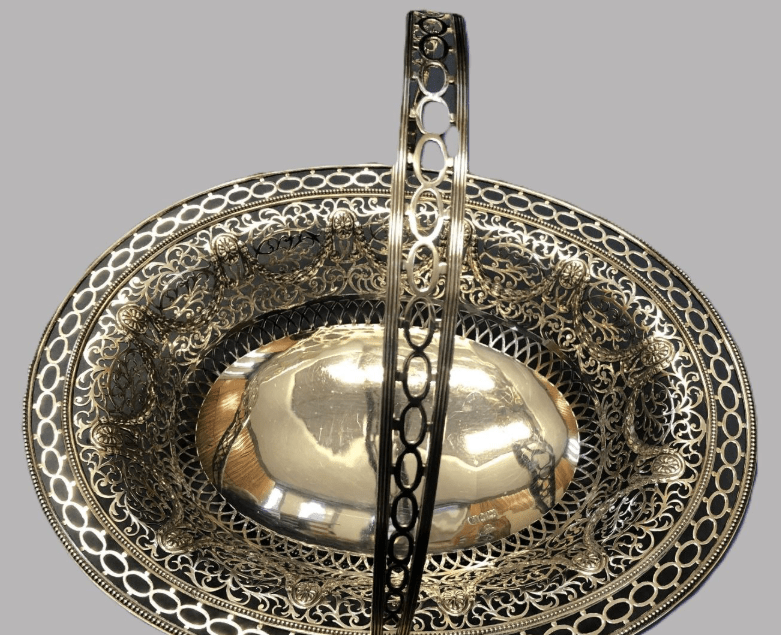
The Kinsey Silver Fruit Basket is by Hemings & Co of London, 1914, and is a reproduction of a 1779 fruit bowl. It was presented to the Company in 2022 by Past Master Alan Kinsey. The underside is engraved: ‘Presented to The Worshipful Company of Upholders By Alan Kinsey, Master 1991-1992, Father of the Company 2020-2022’. It is 13” by 10.75” and stands 10” high with handle raised.
HMS Upholder Model (World War II Submarine) (bronze / gold plate)
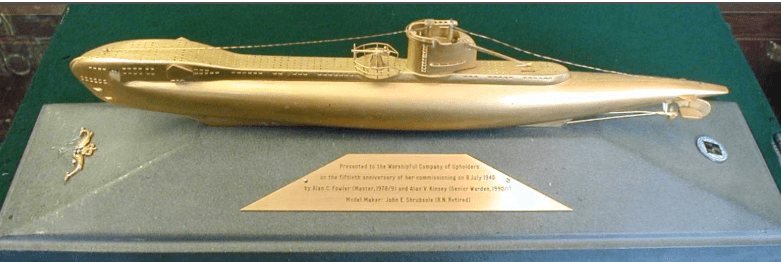
The first model of HMS Upholder is in phosphor bronze and gold plate and is set on a green slate plinth. On the plinth are fixed a silver gilt and enamel coat of arms of the worshipful company of Upholders and a gilt and enamel badge of the submariners. There are also two gilt plaques on the plinth. The first is inscribed: “HM SUBMARINE UPHOLDER lost in action 14 April 1942 Lt. Comm. MD Wanklyn RN VC DSO (2 bars). The most successful British Submarine World War II. Crew awards: 1 VC, 3 DSO, 2 DSC, 7 DSM, 11 Mentions in Despatches.” The second is inscribed: “Presented to the Worshipful Company of Upholders on the fiftieth anniversary of her commissioning on 8 July 1940 by Alan C Fowler (Master, 1978/9) and Alan V Kinsey (Senior Warden, 1990/1). Model maker: John E Shrubsole (RN retired)”.
The Upholders’ Company established a link with the first HMS Upholder during the Second World War, sending the ship’s company books, food parcels and many other comforts. Following her launch on 8 July 1940, HMS Upholder had a short but illustrious career. Under the command of Lieutenant Commander M D Wanklyn RN, she completed 24 patrols before being lost with all hands in April 1942. During her 16 months of service with the 10th Submarine Flotilla, HMS Upholder sank or damaged 22 enemy ships, including three U-boats (sunk), two destroyers (one sunk one damaged) and one cruiser (damaged). She also damaged or sunk 119,000 tons of enemy supply ships.
HMS Upholder Model (World War II Submarine) (silver)
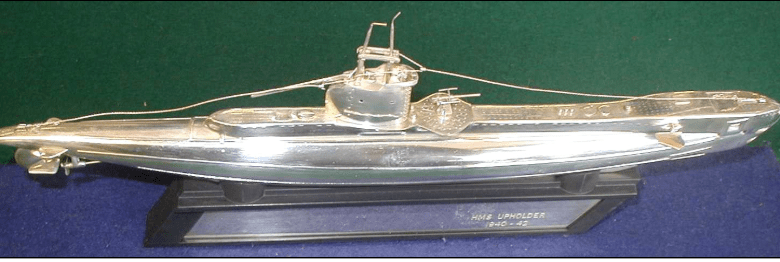
A second submarine named Upholder was launched on 2 December 1986 and commissioned on 9 June 1990. The Company immediately adopted the new HMS Upholder and presented her Captain, Lieutenant Commander GAR McCready MBE RN, with this silver model of the first HMS Upholder. It was displayed in the submarine’s trophy cabinet until she was decommissioned at the end of April 1994, when it was returned to the Company. The submarine now sails with the Royal Canadian Navy as “Chicoutimi”.
Silver Gilt Ley Goblet
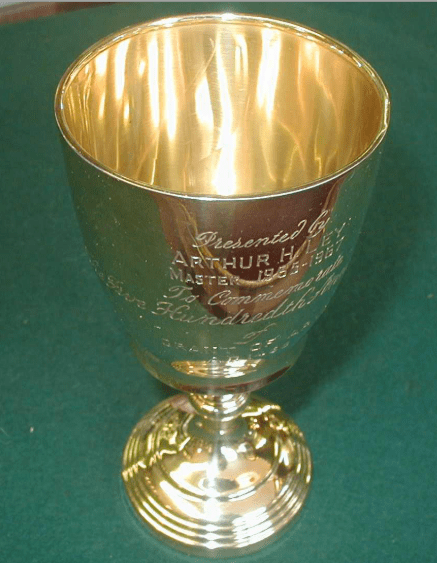
By W.H. Birmingham 1938. Of circular tapering form, on a circular foot with a reeded border. Engraved with the arms of the Company and inscribed: “Presented by Arthur H Ley, Master 1965 – 1967 to Commemorate the Five Hundredth Anniversary of Grant of Arms AD 1965.” Arthur Harris Ley was Sheriff 1964-65. Height 6”, weight 9.4 oz.
Silver Cole Goblet
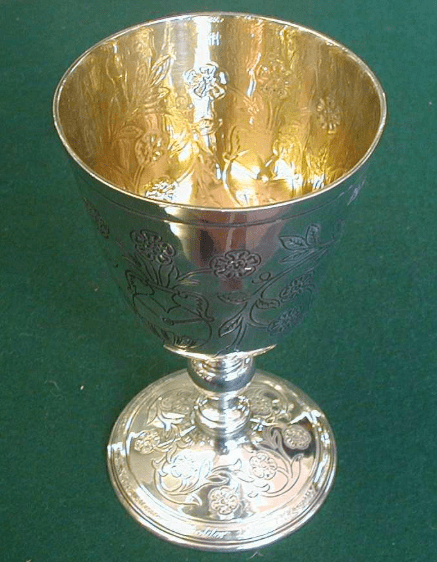
This silver goblet was presented by Col. Raymond Buxton Cole DSO TD DL, Master 1972-73. It is inscribed “The Goblet of R B Cole, Master Upholder 1972 Obt 1991”. By Payne and Son, London 1966. Of bell form, engraved with flowers, vases
and briars, with a gilded interior. Height 6.5”, weight 9.5oz.
Silver Upholders’ Goblets
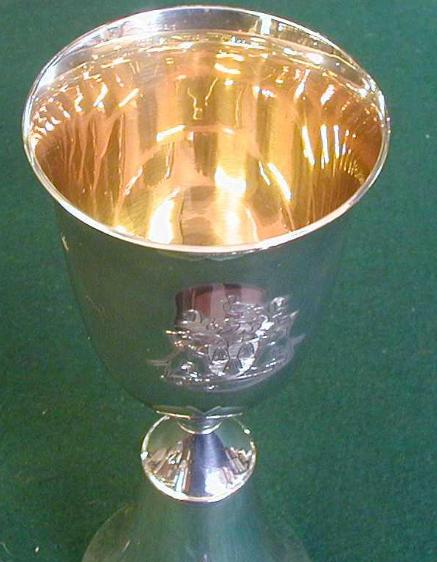
By Bruford and Heming Ltd, London 1992/4. A set of commemorative
silver goblets, with gilded interiors, each engraved with the Company’s coat of arms and with a presentation inscription. On a flared foot. Height 7.5”, weight 53.5oz. Their inscriptions are:
“THE MASTER’S GOBLET. Presented to The Worshipful Company of Upholders by Jonathan Philip Charkham, Master 1979/80 & 1980/81. 9.IV.1992”
“THE WARDEN’S GOBLET. Presented to The Worshipful Company of Upholders by Hugh Edward Taylor, Master 1995/96”
“This Goblet was presented to The Worshipful Company of Upholders by Alan Kinsey, Master 1991/92, for use by the FATHER OF THE COMPANY. 9.IV.1992”
“This Goblet was presented to JONATHAN CHARKHAM, Master 1979/80 & 1980/81, to commemorate his becoming Sheriff of the City of London 28th September 1994”. Jonathan Philip Charkham CBE was Chief Commoner in 2002.
“This Goblet was presented for 45 years of service by NEVILLE BARTON HAYMAN, Master 1952, as Honorary Auditor to The Worshipful Company of Upholders 1949 – 1994.”
Silver Jubilee Salt and Pepper Mills
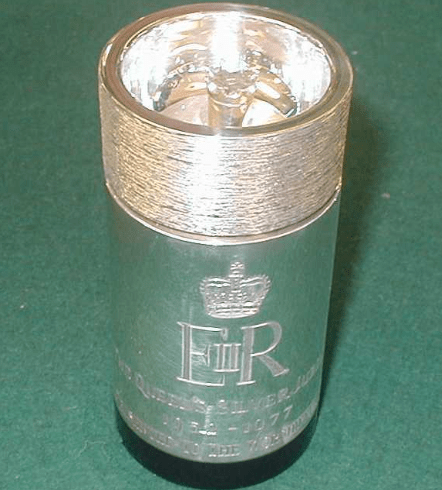
These silver salt and pepper mills were presented to the Company by Alan Victor Kinsey, Master 1991-92. By Mappin and Webb and JAC, London 1977. Of cylindrical form, each engraved with the Royal Cypher and made to commemorate the Silver Jubilee
of Queen Elizabeth II, 1952 to 1977. Height 4.5”.
The Friend Snuff Box
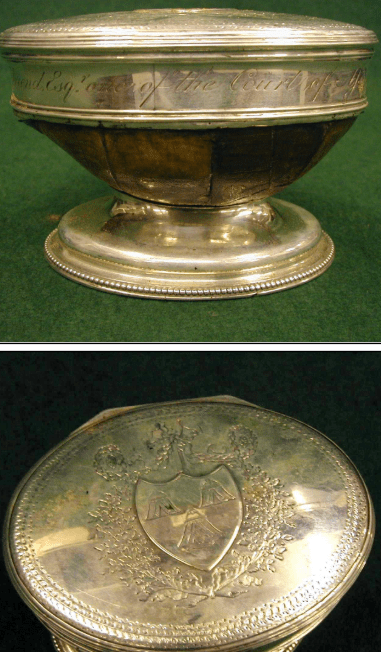
The box was presented to the Company by George Friend, Court Assistant, 1779. The Friend Snuff Box is a George III tortoiseshell snuff box. It is oval in shape, with bright cut engraved silver mounts and tortoiseshell body, with a silver top engraved with the Company’s arms. The silver rim engraved: “The gift of George Friend Esq., one of the Court of Assistants of this Company. Anno 1779.” It stands on oval silver foot and measures 7.6cm x 11.8cm x 9.5cm (3.0” x 4.6” x 3.8”). It was made by Joseph Preedy, circa 1778.
George III Snuff Box
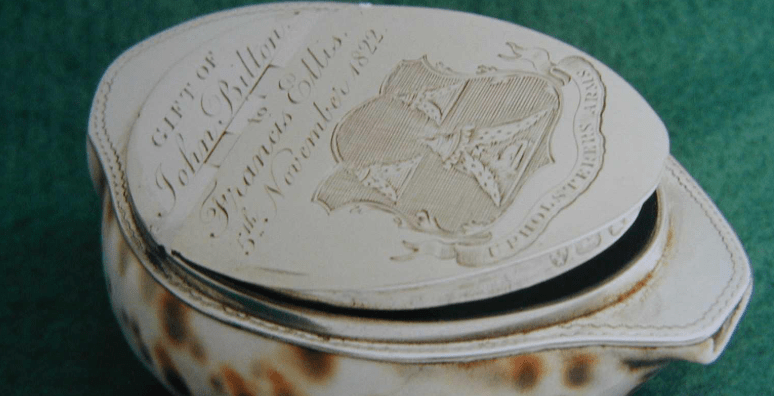
The George III Snuff Box was presented to the Company in 2001 by Alan Victor Kinsey, Master 1991-92. The snuff box is a silver mounted cowrie seashell engraved with the Upholders’ Arms over a scroll inscribed “Upholsterers (sic) Arms”. It is also engraved “Gift of John Bilton to Francis Ellis, 5th November 1822”. It was made by Thomas Watson of Newcastle upon Tyne in around 1820. This gives us an indication of the box’s origins. Among the City of Newcastle’s guilds (known as incorporated companies) are the Upholsterers, whose origins can be traced back to at least 1675 when they received their royal charter. Today, they are linked with Tin Plate Workers and Stationers in a single company (the “Upholsterers”) and are one of 29 active companies in Newcastle. Length 4”, width 3”.
The Master’s Staff
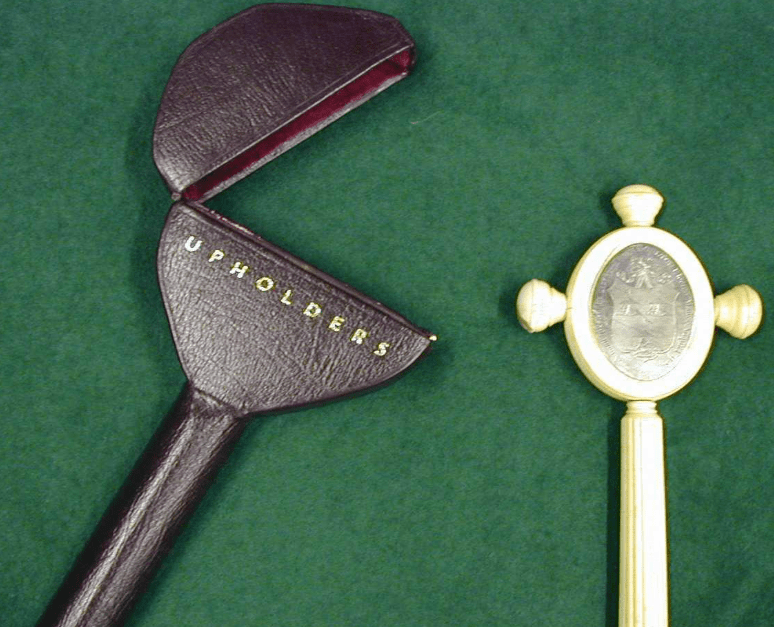
he Staff was presented to the Company by John Boulton, Master 1795. John Boulton traded as an Upholder at 48 Threadneedle Street between 1777 and 1794. The staff is in ivory and has a fluted handle and oval flat top. One side is fitted with a silver shield engraved with the arms of the City of London bordered by the following: “May the Fraternity of Upholders continue forever”. The second side is fitted with a silver shield engraved with the Company’s arms and inscribed: “A small token of respect from John Boulton, elected Master, August 1795.”
The Master’s Chair
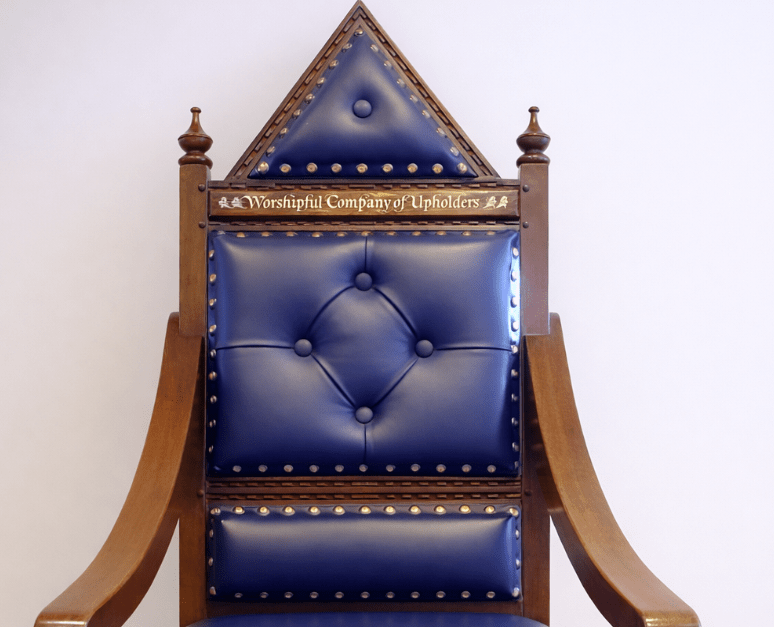
The Master’s Chair is constructed from a wooden frame and is upholstered in blue leather. It is believed to have originated from the 1950s. It is inscribed ‘The Worshipful Company of Upholders’.
South Africa War Medal
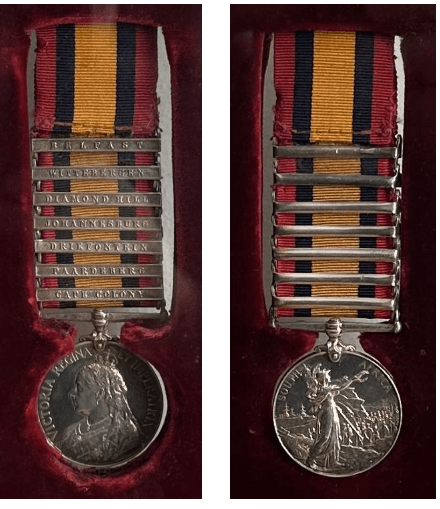
In 1899, support was sought from City Companies to help fund the City of London Imperial Volunteers regiment, for active service in the South African (or Boer) War. Unusually, the campaign medal was awarded to the City Companies that helped to finance the regiment, including the Worshipful Company of Upholders. The whereabouts of the original medal presented to the Upholders in 1901 is unknown. This replacement was presented to the Company by Bertram Chapman (Master 2000-01). This medal, which is mounted in a display case, was originally awarded to 75766 Gunner W Coulson, 5th Battery, Royal Field Artillery. The obverse of the medal shows Queen Victoria, while the reverse depicts Britannia with a standard holding out a laurel wreath to advancing troops. The ribbon has a broad central orange stripe with a blue and a red stripe on either side. There are seven “battle” or “engagement” clasps attached to the ribbon.
Framed 1887 Gold £2 Coin, 2002 £2 Coin and 2002 Golden Jubilee Medal
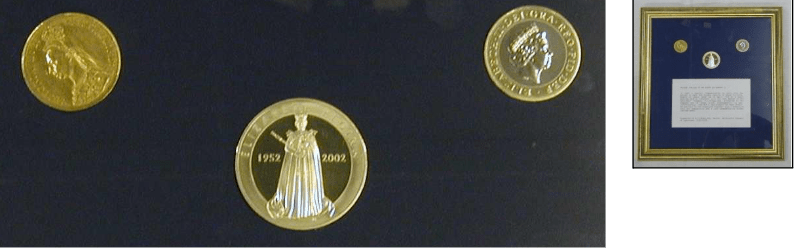
The three coins are mounted in a gold-coloured wooden frame. They are accompanied by a commentary as follows:
“GOLDEN JUBILEE OF HM QUEEN ELIZABETH II
In 1887 a special commemorative £2 gold coin was minted to mark the Golden Jubilee of Queen Victoria. Nearly 50 years later at a Court meeting held at Vintners’ Hall the then Master of the Upholders’ Company, F L Griggs Esq, presented to the Company one of these coins. Subsequently it was, unfortunately, lost but a replacement was obtained and this is now displayed together with a modern £2 coin for comparison and a 2002 commemorative Golden Jubilee medal.
Presented by R C Olney Esq, Master, Worshipful Company of Upholders, 2001/2002.”
Robert Carroll Olney was the first American to become Master of a City Livery Company and can also trace his ancestry back to John Olney who became Lord Mayor of London in 1446.
Wynne Gilham Memorial Badge Presentation
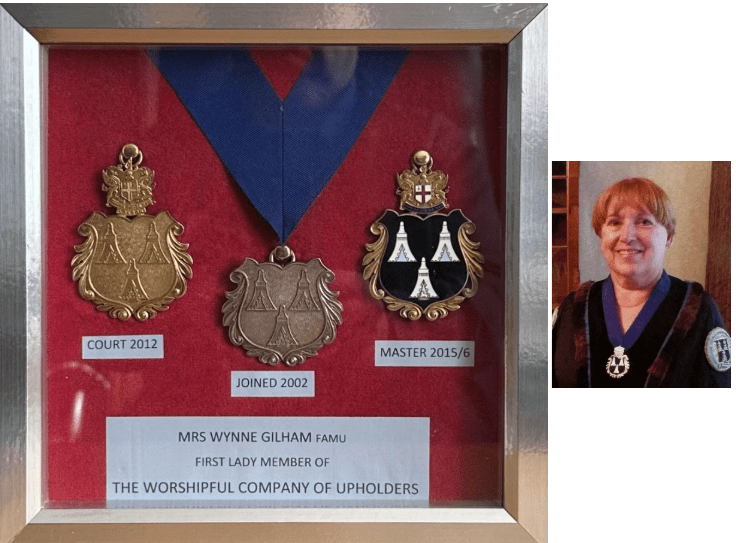
Wynne Gilham FAMU was the Company’s first lady Liveryman, elected in 2002. She was elected to the Court of Assistants in 2012 and served as the Company’s first Lady Master in 2015-16. The theme for her Master’s year was the promotion of highest standard of trade practices within the soft furnishing and upholstery industry, with a focus on young people.
Sadly, Wynne passed away in 2018. This framed presentation of Wynne’s Livery badges (Liveryman, Court Assistant and Past Master) was presented to the Company by her husband, Past Master Michael Gilham, at the January 2023 Court Meeting to commemorate her service to the Company and its associated trades.
AMU Presentation Hammer
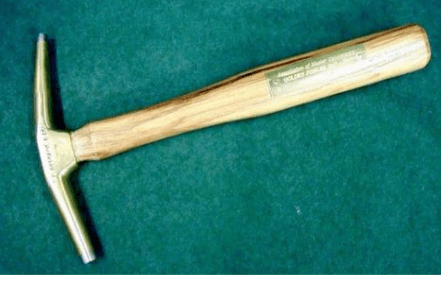
This hammer was presented to the Company by the Association of Master Upholsterers and Soft Furnishers in 1997. The hammer measures 27.3cm (10.8”) in length and has a plaque inscribed: “Association of Master Upholsterers and Soft Furnishers Golden Jubilee 1947 – 1997”.
Presentation Quill Pen
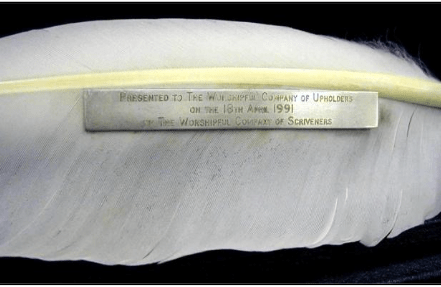
The quill pen is white in colour with a silver plaque which is inscribed: “Presented to the Worshipful Company of Upholders on 18th April 1991 by the Worshipful Company of Scriveners”. It is 41.3cm (16.3”) in length and has a black presentation case.
Commemorative Baton

This baton commemorates George V’s Silver Jubilee, May 1935. It is inscribed: “HM George V Silver Jubilee Service, St Pauls’ Cathedral, 6th May 1935”.
Gavel and Block
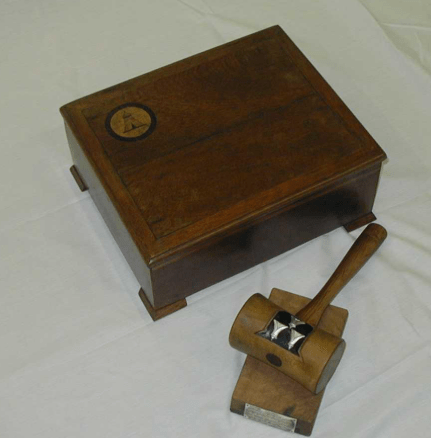
The gavel and block were presented to the Company by L R Beagen Esq, a Freeman of the Company, on 20 September 1966. The wooden gavel bears the Company’s Arms which are carved and painted. The fitted case is inlaid with the Company’s Arms. Contained in an oak box. Length 10.5”.
London Bridge Jewel Box
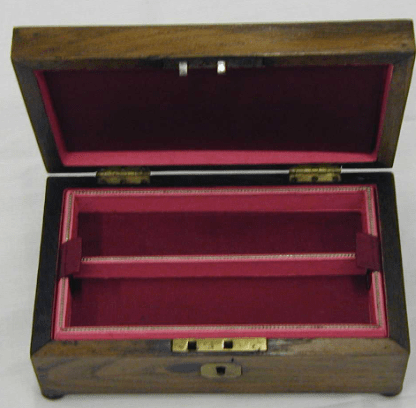
This jewel box is rectangular in shape with a red velvet lined interior, and brass plaque inscribed: “The oak of this case was 656 years under Old London Bridge.” The dimensions of the box are 20.7cm x 12.7cm x 8.3cm (8.1” x 5.0” x 3.3”).
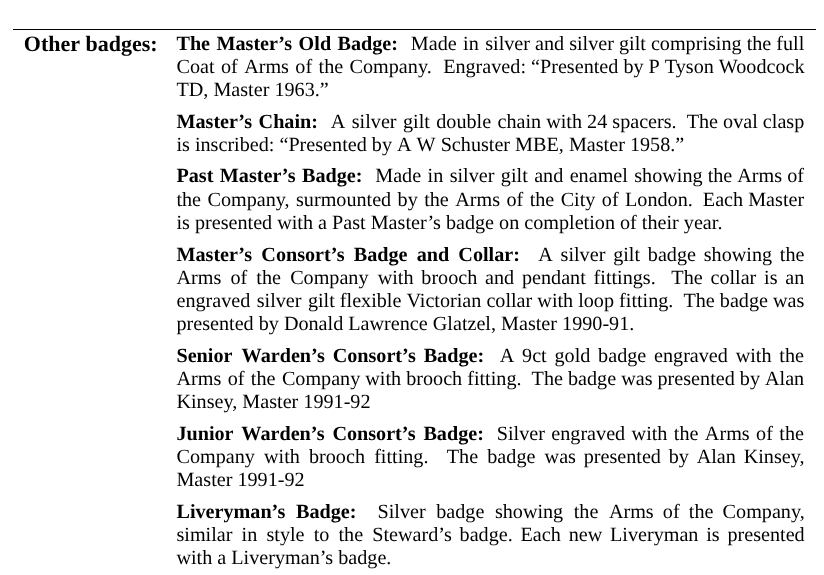
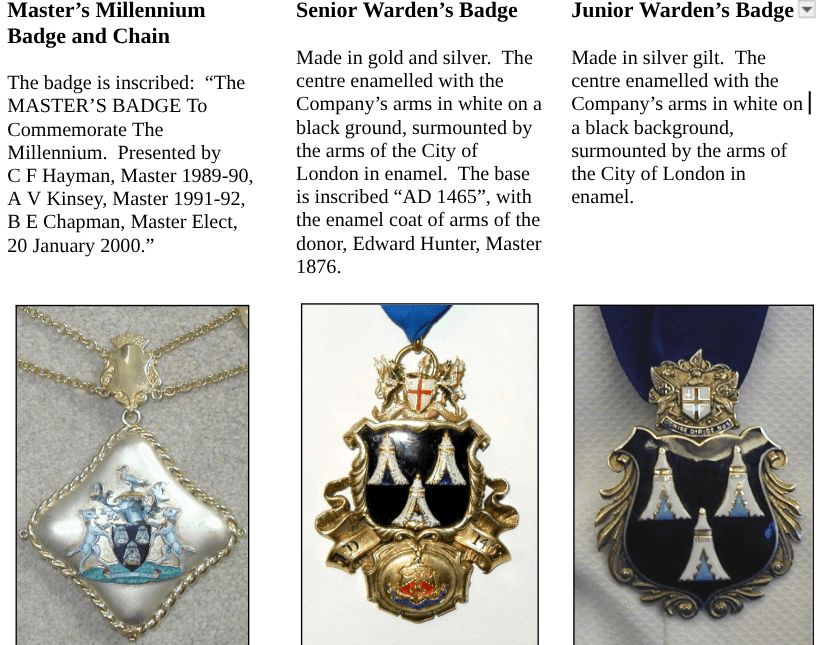
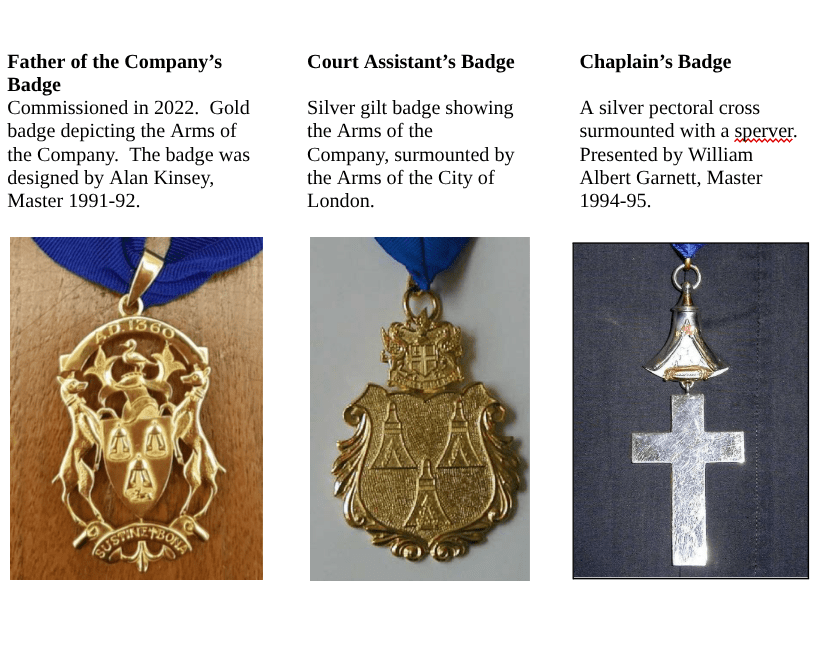
Badges of Office
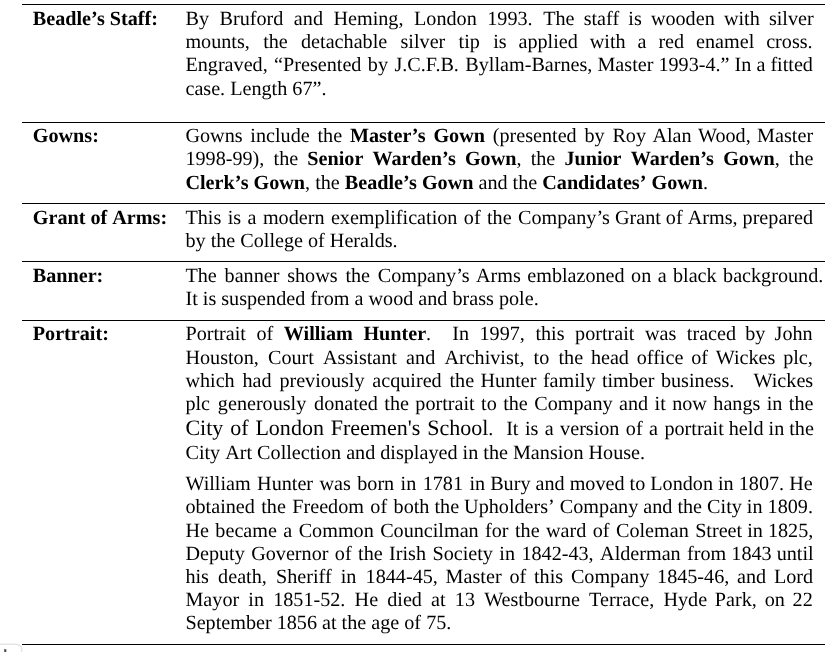
Other Treasures